
Flip Top Cap Mould, Bump Lotion & Closure Mould
China’s leading reliable plastic cap mould supplier with over 15 years of experience. One stop service — quick delivery, rich experience, top quality. Mould steel P20, H13 and S136.

- 15+ years cap mould experience
- 7 cap mould types
- P20 / H13 / S136 steel
- Design to delivery, one stop
Your one-stop cap mould partner
Topworks è il principale fornitore cinese di stampi per tappi in plastica con oltre 15 anni di esperienza. Il nostro servizio unico offre consegne rapide, una ricca esperienza e stampi per tappi di alta qualità.
Abbiamo un'ampia scelta di stampi per tappi in plastica di alta qualità, ideali per lo sviluppo del prodotto, la prototipazione e la produzione.
Ci dedichiamo a realizzazione di stampi per tappi di qualità with mould steel P20, H13 and S136.
Cap mould range
- Stampo per chiusure a cerniera
- Stampo a beccuccio Yorker
- Stampo per tappo a disco
- Stampo per tappi a ribalta
- Stampo per tappi push-pull
- Stampo per tappi con apertura/chiusura a torsione
- Stampo per chiusure a ribalta

Cap & closure mould gallery


How to design screw cap, lid & closure moulds
Undercuts on the inside of a cap — typically inside threads, snap-on ribs, or major undercuts that are part of the product shape — require careful design decisions. The planned method of manufacture (molding, or machining after molding) should be considered. The stampo per tappi potrebbe essere molto più semplice se il tappo fosse filettato dopo lo stampaggio. È più importante arrivare al prodotto dal costo totale più basso che al metodo di produzione più elegante.
Inside threads on cap
Se la filettatura deve essere modellata, ci sono due possibilità di rimozione del prodotto dal nucleo: svitando o spellando. Il progettista deve considerare attentamente le quantità di produzione richieste. La lavorazione dopo lo stampaggio può ridurre significativamente la complessità e il costo dello stampo per i volumi più bassi.
Unscrewing method
Le filettature progettate a norma sono solitamente composte da più di un passo. In molti tappi a vite per bottiglie, barattoli e tubetti di dentifricio, da due a sei tiri sono abbastanza comuni. More turns mean longer products, more plastic, more molding time, and longer cycles. In many closures, a thread length of one or two pitches is sufficient for good holding power.
Il anello spogliatore tiene il tappo in modo che possa essere svitato dal nucleo. Il tappo necessita di nervature o sporgenze all'esterno in cui possa agganciarsi un dispositivo di svitatura esterno. La progettazione di questi ausili deve essere discussa con il progettista di stampi.
Qualsiasi metodo di svitatura richiede un complicato stampi per tappi o macchine speciali. Anche i cicli di stampaggio sono più lenti rispetto a prodotti analoghi che non devono essere svitati.
Espulsione di stripping (espulsione forzata)
Lo stripping è la soluzione più semplice e spesso più economica per espellere il tappo o la chiusura. Poiché il stampo per tappi opens and after the cavity has moved away from the core side, the ejection starts caused by the stripper moving forward. The plastic cap is pushed over the hump in the core, causing the plastic to expand so that the portion inside the groove can slip out.
La facilità di spelatura dipende da molti fattori altrettanto importanti: l'angolo di filettatura, l'altezza della sporgenza, il diametro, il tipo di plastica e il suo modulo di elasticità.
Factors affecting stripping ability
Angolo di filettatura (α): Maggiore è l'angolo, più difficile è l'azione di spellatura. Un angolo acuto (α = 90°) rende praticamente impossibile l'espulsione: il tappo di plastica si staccherebbe nella scanalatura anziché estrarsi.
Altezza “h” e diametro “d”: The percentage of stretching f is directly proportional to height h and inversely proportional to diameter d. The greater the cap diameter d, the easier the cap will slip out of its groove. A cap from relatively stiff plastic could be stripped if d is large, but would break during ejection if d is small.
Numero di filettature (passi): Il modo più semplice per spelare è specificare un solo filetto (un passo) in modo che il filetto spelato non scivoli in una scanalatura adiacente ma continui a scorrere ininterrottamente dal nucleo.
The finish of the groove also influences the ease of stripping, especially with materials requiring high polish for good ejection.
Figure 1 — Stripping influences
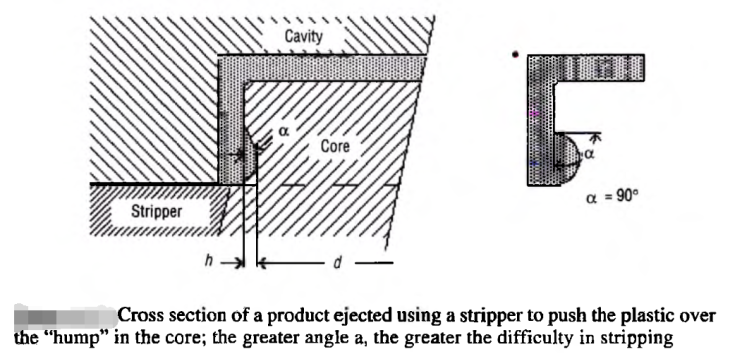
Influences affecting the ability to strip a cap. The greater the angle α is, the greater the difficulty in stripping. Le filettature delle viti possono avere un angolo di 90° se assolutamente necessario., ma questo richiederebbe sicuramente uno svitamento, non sarebbe possibile svitarlo.
Many screw threads — especially threads for closures — have standardised shapes which originally evolved from threads on glass bottles and jars. Such standards should be followed, and their large tolerances used to obtain maximum benefits for plastic threads.
Considerando tutti i fattori che influenzano la spanatura, il progettista riuscirà a creare un tappo a vite con la giusta forma della sezione trasversale della filettatura e un rapporto h/d adeguato, in modo che anche una plastica relativamente rigida possa essere facilmente spanata, senza la necessità di uno svitamento. stampo per tappi.
Need a cap or closure mould?
Send your cap drawing, material spec, and annual volume. We’ll reply with DFM notes, steel recommendation, and a clear quotation.
- Flip-top, hinged, disc-top, push-pull, twist, yorker, flapper
- P20 / H13 / S136 mould steel
- 15+ years cap mould experience
- Quick delivery, one stop service
Cap & closure mould FAQ
What types of cap moulds do you make?
We manufacture moulds for flip-top caps, hinged closures, disc-top caps, push-pull caps, twist open/close caps, yorker spout caps, and flapper closures — covering bottles, jars, tubes, and cosmetic packaging.
What mould steels do you use for cap moulds?
P20 for general production, H13 for high-wear and abrasive-filler applications, and S136 for corrosion resistance with aggressive resins. Steel choice depends on resin, surface requirement, and target mould life.
Should cap threads be molded or machined after molding?
It depends on volume. For high-volume production, molding the threads is more efficient — the cap mould uses unscrewing or stripping ejection. For lower volumes, machining threads after molding can simplify the mould and reduce cost significantly.
What is the difference between unscrewing and stripping ejection?
Unscrewing rotates the cap off the core — required for deep or sharp-angle threads, but needs a more complex mould and longer cycle. Stripping pushes the cap over the core hump by force — simpler and faster, but only works when thread angle, h/d ratio, and plastic flexibility allow it.
How do I know if my cap design can be stripped?
Key factors: thread angle α (must not be 90°), projection height h relative to cap diameter d (smaller h/d = easier stripping), number of pitches (one pitch is easiest), and the plastic’s modulus of elasticity. We run DFM analysis to confirm strippability before cutting steel.
What is the typical lead time for a cap mould?
30–50 days from design approval depending on cap type, cavity count, and unscrewing mechanism complexity. Trial parts and inspection reports are provided before shipment.
Can you make multi-cavity cap moulds?
Yes. Cap moulds commonly run 4, 8, 16, or higher cavities depending on annual volume and press size. Higher cavitation lowers per-part cost but increases mould investment and lead time.