Plastic Dustbin Mould, Garbage & Trash Bin Mould Maker
We are a dedicated maker of industrial plastic dustbin, garbage-bin and trash-bin moulds — from household bins to 120L+ waste containers. HDPE tooling in P20 steel, cold-runner bodies with hot-runner lids, and loose-bar designs that solve the long-draw ejection problem.

- Household to 120L+ bins
- P20 steel, HDPE, ~200k shots
- Cold-runner body, hot-runner lid
- Loose-bar ejection design
120L dustbin mould specification
- Cavity
- 1
- Dustbin size
- 932 × 492 × 550 mm
- Mould life
- 200,000 shots
- Injection gate (body)
- Cold runner
- Injection gate (lid)
- 1-drop hot runner, HOTSET heat coil (Germany)
- Mould steel
- P20
- Plastic material
- HDPE
Dustbin mould making and design
A moulded dustbin sometimes cannot be removed directly from the mould as it opens — the bin is undercut relative to the line of travel.
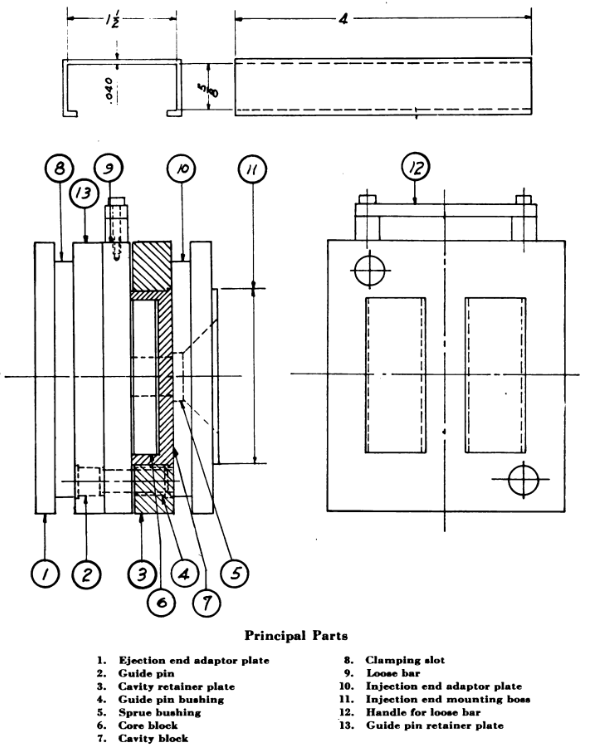
The usual practice is to modify the design as much as possible to keep the mould simple. But a tall, thin-section bin — for example a long draw of 4 inches with a 0.040-inch wall — cannot be ejected endwise on opening, because ejector action depends on opening travel and the mould would need to be at least twice the length of the bin. That is where the loose-bar design earns its place. Note the risk of lavello on thick sections.
The loose-bar solution
By moulding the bin over a core attached to a loose bar, a long-draw, thin-section dustbin can be produced without a bulky endwise tool. The loose bar carries the core out with the moulding, then the bin is stripped from the bar off the press — a clean answer to an ejection problem that would otherwise force a much larger, more expensive mould.

Need a dustbin or waste-bin mould?
Send your bin drawing, size and volume. We’ll advise on cavity, steel, runner and ejection, and quote the tool.
- Round, square, pedal & wheelie bins
- HDPE tooling in P20 or harder steel
- Loose-bar & slide ejection design
Dustbin mould FAQ
What are the specifications of a 120L dustbin mould?
A typical 120L dustbin mould is single-cavity, part size around 932×492×550 mm, mould life about 200,000 shots, cold-runner gate on the body and a 1-drop HOTSET hot runner on the lid, P20 mould steel and HDPE material.
Why do dustbin moulds use a loose-bar design?
Because a tall, thin-section bin is undercut relative to the opening direction and cannot always eject directly. Moulding over a core on a loose bar overcomes the long-draw, thin-section ejection problem without making the tool twice the length of the bin.
What material and steel are used for dustbin moulds?
HDPE is the standard resin — tough, UV-friendly and impact-resistant. P20 is the usual mould steel; see our plastic mould steel guide for alternatives on higher-volume tools.
How many shots will a dustbin mould last?
A P20 dustbin tool is typically rated around 200,000 shots. For higher volumes we move to harder steel in the wear areas so the tool holds up over a longer run.
Can you make different dustbin sizes and types?
Yes — round and square bins, pedal bins, wheelie bins and industrial waste containers, from small household bins to 120L+ garbage and trash bins, each sized to your design and volume.