Buying a Cutlery Mould Without Getting Burned
A mould is the one purchase in disposable-cutlery production you can’t quietly fix later. Here’s what actually matters before you sign off — written for the person doing the sourcing, not the spec sheet.

Most people come to cutlery moulds backwards. They’ve already got a market for plastic spoons or forks, a rough idea of how many they need to sell, and a quote sitting in their inbox that’s either suspiciously cheap or alarmingly expensive — and no way to tell which. The mould is the bit in the middle they understand least, even though it’s the bit that quietly sets their cost-per-spoon for the next several years.
So let’s fix that. By the end of this you’ll know what the numbers on a cutlery-mould quote actually mean, where suppliers cut corners, and the handful of questions that separate a tool you’ll be happy with from one you’ll resent.
First, a quick fork in the road.
“Cutlery mould” is used for two completely different tools. This guide is about the plastic injection mould — the steel tool that shapes molten plastic into disposable spoons, forks and knives. If you’re making metal flatware, you want a stamping or stretching die instead: different machine, different steel, different supplier entirely. If that’s you, stop here — none of the numbers below apply.
1.The mould isn’t really one decision — it’s four
When a supplier sends you a quote, the price is the sum of four choices: how many cavities, what plastic you’re running, what steel the tool is cut from, and how the plastic gets into the cavities (the runner system). Change any one and the number moves. Understand all four and you stop being a passenger.
Let’s take them in the order they actually matter.
2.Cavities: start from output, never from price
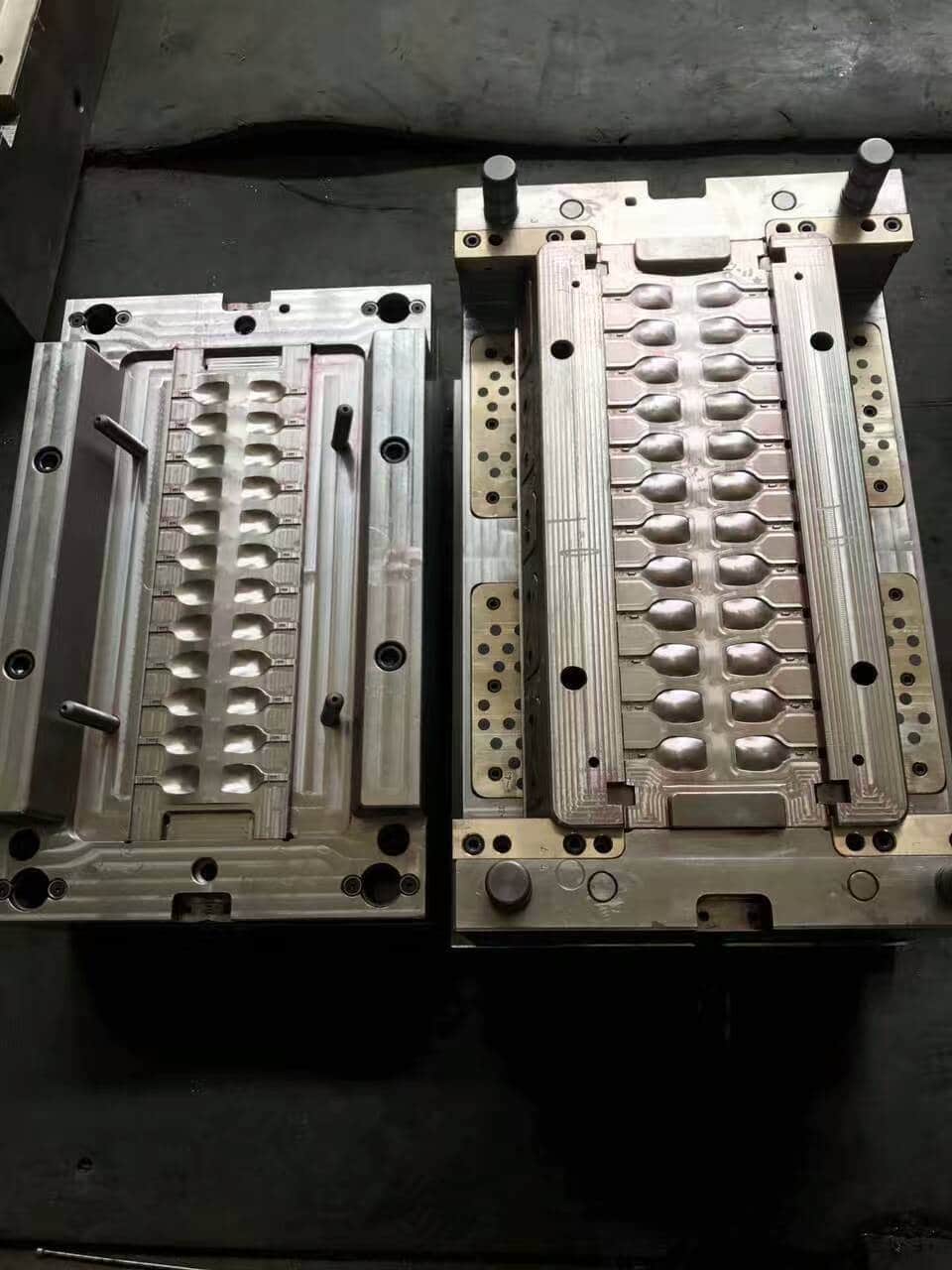
The cavity count is how many spoons (or forks, or knives) the tool spits out per shot. Sixteen cavities means sixteen spoons every cycle; sixty-four means sixty-four. It’s the first thing any supplier will ask you, and it’s where buyers make their first mistake — they pick a number to fit a budget instead of working backwards from how much they need to sell.
Do it the right way round. Take your monthly demand, a realistic cycle time (cutlery runs fast — often five to eight seconds a shot), and the hours you’ll actually run the line. The arithmetic tells you the cavity count, not the other way around.
Say you need 10 million spoons a month. A 32-cavity tool on a 6-second cycle, running 20 hours a day for 26 days, gives you roughly 312,000 shots — about 10 million spoons. It just covers it. So in practice you’d size up to 48 cavities for breathing room, or run two 32-cavity lines so one breakdown doesn’t sink the month. Run this with your real numbers before you fall in love with a cavity count.
One genuinely useful trick: the stack mould. It puts two cavity faces back-to-back in a single tool, so you roughly double output without buying a bigger, pricier injection machine. If you’re volume-hungry but machine-constrained, ask about it.
3.The plastic comes before the steel
This catches people out: you have to decide what plastic you’re moulding before the mould is cut, because the cavity is machined slightly oversized to allow for the plastic shrinking as it cools — and every plastic shrinks differently.
The two workhorses are PP and PS. PP (polypropylene) is flexible and tough — it bends rather than snaps, which gives cutlery a more reassuring, less cheap feel. PS (polystyrene) is rigid, glossy and cheaper, but brittle enough to crack if someone leans on it. PP shrinks about 1.7% as it cools; PS only about 1.05%. That difference is baked into the tool, which is exactly why you can’t swap materials afterwards and expect the dimensions to hold.
Two more worth knowing. PLA is the plant-based, compostable option — it’s having a moment as buyers chase eco credentials, and it moulds on standard cutlery tooling, but it’s more brittle and far less heat-tolerant, so tell your mould maker up front so they design the cooling and ejection around it. And PE shows up where you want genuine flex and chemical resistance, though it’s too soft for a proper knife.
Lock the plastic first. The mould is built around it, not the other way round.
4.Steel is where the cheap quotes hide
Here’s the part suppliers would rather you didn’t scrutinise. Cutlery is moulded fast and under high pressure, so the steel has to be hard enough to take millions of cycles and polish well enough to release thin, glossy pieces cleanly. Better steel costs more and lasts longer — and a “cheap” quote is very often a cheap-steel quote.
You’ll see grades like P20, 718 and 2738 (pre-hardened, softer, fine for lower volumes and budget builds) versus H13, 2344 and S136 (hardened, the right call for high-speed cutlery cavities). S136 in particular brings corrosion resistance and a high polish — handy for clear, food-contact pieces. For cutlery, the cavities are commonly machined in H13, S136 or 2344 around 45–48 HRC hardness, and as a durability benchmark you want the core and cavity sitting north of about 52 HRC for the longest life.
Don’t accept “good steel.” Ask: “What grade is the cavity, and what’s its hardness in HRC after heat treatment?” A supplier who won’t give you a straight answer is telling you something. Two quotes that look similar can be hiding a P20 tool against an S136 one — same price today, very different lifespan.

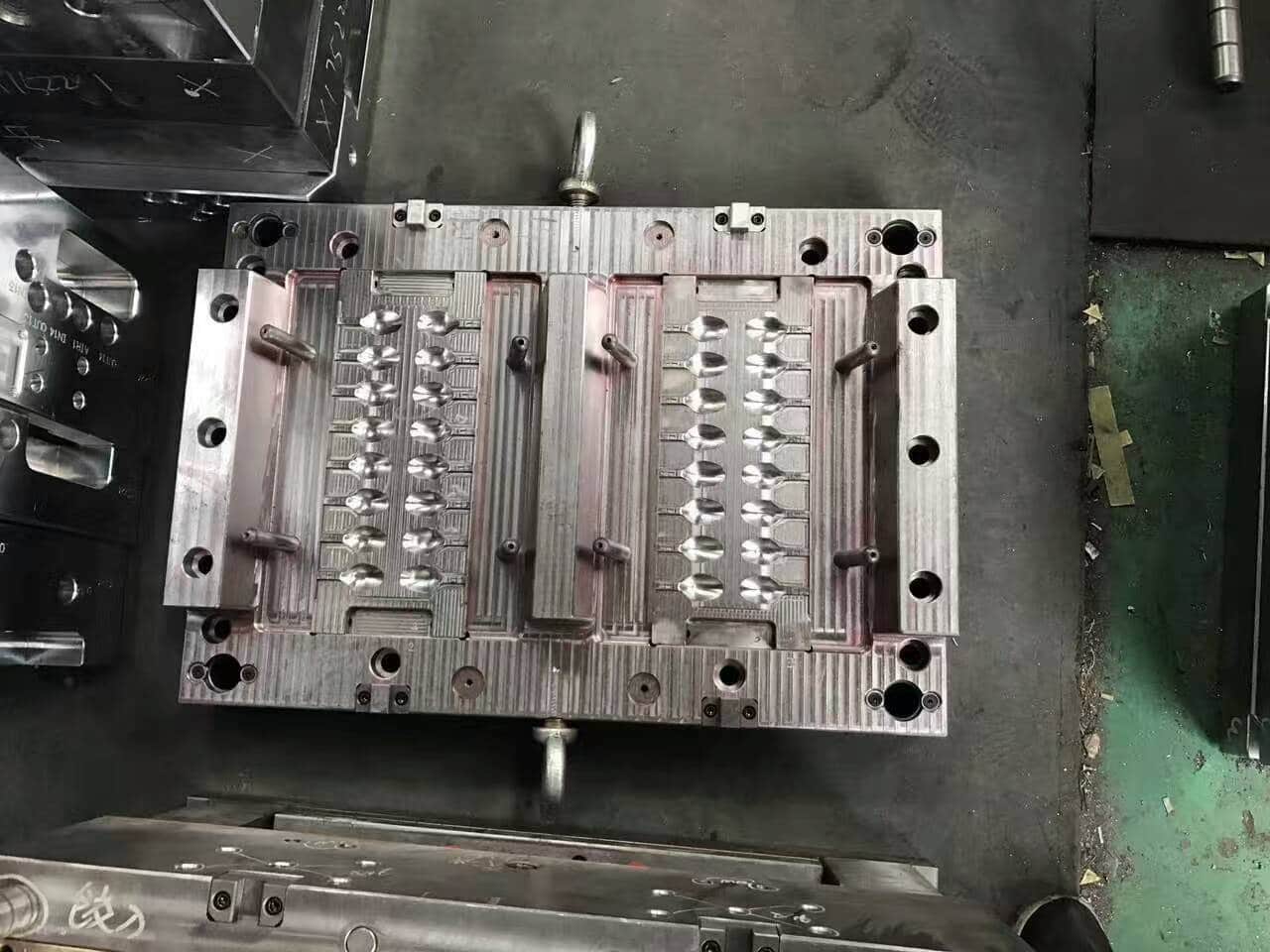
Cavity and core detail — the polish quality here directly affects surface finish and ejection reliability on every shot.
5.Runner system: pay now or pay forever
The runner system is how molten plastic travels from the machine into each cavity, and the choice is a straight trade-off between what you spend upfront and what you waste on every single shot.
| Type | Upfront | Waste per shot | Suits |
|---|---|---|---|
| Hot runner | Highest | Lowest | High volume, running continuously |
| Semi-hot | Middle | Some | Mid volume, balanced budget |
| Cold runner | Lowest | Highest | Lower volume, tight cash |

The instinct is to grab the cheapest runner to keep the quote down. Sometimes that’s right. But do the lifetime sum first: a full hot runner with valve gates at each cavity is what lets thinwall cutlery run at its fastest, cleanest cycle with no runner scrap to regrind. If that saves you a few percent of material on every one of a million-plus shots, it can pay for itself long before the tool retires. Ask your supplier to model both against your actual annual volume — a good one will, without being pushed.
6.“One million shots” — true, with an asterisk
Every supplier promises “more than one million shots.” It’s a fair headline when the build backs it up, and meaningless when it doesn’t. The industry shorthand for this is the SPI mould classes: a tool genuinely built for a million-plus cycles (Class 101/102) has a hardened base, hardened molding surfaces, guided ejection and parting-line locks. A million-shot promise stamped on a soft-steel, lightly-built tool is just marketing.
What actually wears a cutlery mould out is rarely dramatic. Flash — plastic leaking at the parting line — slowly chews up the surfaces it escapes from. Surface delamination turns ejection into sandpaper on the cavity. And the quiet killer is simply skipped maintenance: clean the mould faces daily, lubricate the pins and slides, inspect for early cracks, and store it somewhere dry. None of that is glamorous, and all of it adds years.
7.So what does it cost?
There’s no sticker price, because those four choices — cavities, runner, steel, complexity — move the number more than any supplier’s margin does. Folding cutlery (which needs slides) and family moulds that make a spoon, fork and knife in one tool sit at the dearer end; a simple single-product, low-cavity, cold-runner tool sits at the cheap end.
As rough orders of magnitude for China-built cutlery moulds: a simple low-cavity cold-runner tool can start in the low-to-mid four figures (USD); a mid-spec 24–32 cavity semi-hot tool often lands in the low-to-mid five figures; a high-cavity 48–64 hot-runner or stack mould can reach the mid-five figures and up. These swing hard with steel and runner choice — treat them as a sanity check, not a price, and always get itemised quotes from three suppliers.
And compare on the right thing. The headline price is the wrong metric; cost per piece over the life of the tool is the right one. A pricier hot-runner, hardened-steel mould that runs faster, wastes less and lasts longer routinely beats the “cheap” option once you’ve made your ten-millionth spoon.
8.Vetting the supplier (most moulds come from one region)
The overwhelming majority of cutlery moulds are built in China, clustered around Taizhou and Huangyan — anything from small shops turning out a couple of hundred mould sets a year to large factories making close to a thousand. The depth of the market is a real advantage; the variance in quality is the catch. A bit of diligence is the whole game.
Before any deposit leaves your account:
- Ask for samples of cutlery they’ve actually produced — look at the edges, check for flash, weigh a few pieces to see how consistent they are.
- See the factory, in person or on a live video call, and confirm they own the high-speed machining the job needs rather than subcontracting it out quietly.
- Get the spec in writing — steel grade and HRC, cavity count, runner type, guaranteed cycle time, expected life in shots. If it’s written down, you can hold them to it.
- Insist on a T1 trial sample and an acceptance run before the final payment. Good shops hold the weight difference between cavities to a fraction of a gram.
- Nail the logistics — moulds usually ship FOB Ningbo or Shanghai in a wooden case; agree who’s covering freight, duties and insurance.
And the tells that should make you walk: a refusal to name steel or hardness, a million-shot guarantee on a budget quote, no trial sample offered, a price wildly below everyone else’s, and a page full of keyword-stuffed promises with not a single concrete spec on it. If they can’t talk specifics, they can’t deliver them.
Get the four choices right, ask the steel question, and check the samples — do that and a cutlery mould stops being a leap of faith and becomes what it should be: a boring, dependable machine that quietly prints your product for years.
Want a quote you can actually read?
Send us your target output, your plastic and your budget. We’ll come back with cavity count, steel grade, runner system and lead time — and the cost-per-piece worked out, so the decision’s an easy one.
Quick answers
What plastic is used to make cutlery moulds?
The cutlery is usually moulded from PP or PS, with PLA for compostable lines and PE or ABS for flexible or heavy-duty pieces. The mould that shapes them is tool steel — H13, S136 or 2344 — not plastic.
How many cavities do I need?
Work backwards from output. Take your monthly demand and a realistic cycle time and the cavity count falls out of the maths. Common counts are 16, 24, 32, 48 and 64; 32 is the everyday workhorse. A stack mould roughly doubles output without a bigger machine.
How long does a cutlery mould last?
A properly hardened tool can clear a million shots; a soft-steel one might only reach a few hundred thousand. The grade, hardness, build standard and your maintenance habits decide it — not the supplier’s headline claim.
Hot runner or cold runner?
Hot runners cost more upfront but waste the least material and run fastest, so they win on high volume. Cold runners are cheap to build but scrap a runner every shot. Semi-hot sits between. Choose on lifetime material cost, not the quote alone.
How much should I expect to pay?
It depends on cavities, runner, steel and complexity rather than a fixed rate — simple tools start in the low thousands of dollars, high-cavity hot-runner tools run well into five figures. Compare itemised quotes on cost per piece, not headline price.
PP or PS for disposable cutlery?
PP flexes and feels better; PS is cheaper, glossier and more brittle. Pick PP for durability, PS for lowest cost — and decide before the mould is cut, since each needs a different shrinkage allowance.