
The Complete Guide to Injection Mold Structure & Components
Understand every component inside an injection mold — from the sprue bushing to the ejector pins. A visual, step-by-step educational guide for students, new engineers, and curious minds.
Introduction: Why Understanding Injection Mold Structure Matters
The foundation of modern manufacturing, explained simply.
Injection molding is one of the most widely used manufacturing processes in the world. From the phone case in your hand to the dashboard of your car, injection-molded parts are everywhere. But behind every perfectly formed plastic part sits a precision-engineered tool: the injection mold.
If you’re a student, a new engineer, a product designer, or simply curious about how everyday plastic products are made, understanding the structure and components of an injection mold is a foundational skill. It’s the difference between vaguely knowing “plastic gets shaped” and truly understanding how and why parts look and perform the way they do.
By the end of this guide, you will:
Common Pain Points & Challenges for Beginners
If any of these resonate, you’re in the right place!
Section 1: What Is an Injection Mold?
The Big Picture — Understanding the fundamentals before the details.
An injection mold (also called an injection molding tool or die) is a custom-made metal block that has been precision-machined to contain a hollow space (a cavity) in the exact shape of the plastic part you want to produce.
🔑 Key Concept
A mold is NOT one solid block. A standard injection mold is an assembly of many individual plates, inserts, pins, channels, and mechanisms — often containing hundreds of components working together with incredible precision.
💡 Best Practices & Tips
- Think of a mold like a sandwich — it’s made of stacked plates, each with a specific purpose.
- Always start by identifying the two halves (Section 2) — everything else branches from there.
- Molds are typically made from hardened steel or aluminum. Steel molds last longer (millions of cycles); aluminum molds are cheaper (for prototyping).
Section 2: The Two Halves — Core Side vs. Cavity Side
Every injection mold splits into two main halves. Here’s how they work.
| Half | Also Called | Position | Key Role |
|---|---|---|---|
| Cavity Side (A-Side) | Stationary half, Fixed half | Attached to the machine’s fixed platen | Contains the cavity (outer shape/surface) & sprue bushing |
| Core Side (B-Side) | Moving half, Ejector half | Attached to the machine’s moving platen | Contains the core (inner shape) & ejection system |
When the machine closes, the two halves press together tightly. The space between them is the mold cavity — the negative shape of your part. When the machine opens, the core side pulls away, and the part (which typically shrinks onto the core) is ejected.
💡 Best Practices & Tips
- The parting line is where the two halves meet. It’s visible as a faint line on finished parts — look for it on products around you!
- Draft angles (slight tapers) are added to the core to help the part release easily.
- When examining a real mold, always start by identifying the parting line — it orients everything else.
Section 3: The Mold Base — The Structural Backbone
The standardized framework that holds everything together.
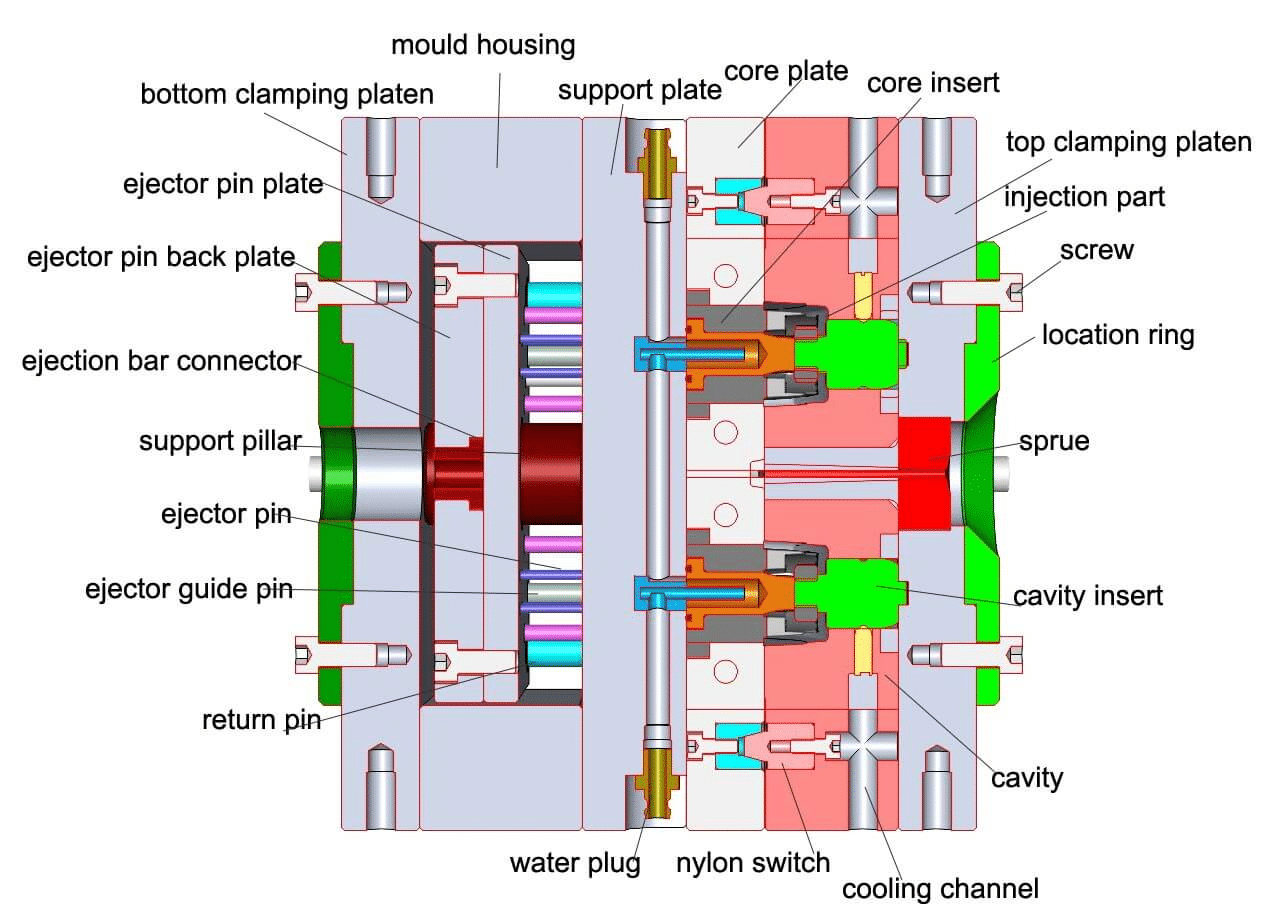
The mold base is the standardized structural framework that holds all the custom components in place. Think of it as the chassis of a car — it doesn’t shape the plastic itself, but without it, nothing works.
Standard Mold Base Plates (Top to Bottom):
Key Components Explained:
| Component | Function |
|---|---|
| Top Clamping Plate | Secures the A-side (cavity) to the machine’s fixed platen. |
| A-Plate (Cavity Plate) | Houses the cavity insert or has the cavity machined directly into it. |
| B-Plate (Core Plate) | Houses the core insert or has the core machined directly into it. |
| Support Plate | Sits behind the B-plate to prevent bending under injection pressure. |
| Spacer Blocks / Rails | Create the ejector box space so ejector plates can move. |
| Ejector Plates (2 plates) | Hold and move the ejector pins forward to push the part out. |
| Bottom Clamping Plate | Secures the B-side (core) to the machine’s moving platen. |
💡 Best Practices & Tips
- Standard mold bases are available from companies like DME, HASCO, and Misumi — designers rarely build from scratch.
- Understanding the plate stack-up is essential before learning anything else.
- Plate thickness matters — thicker support plates resist deflection during high-pressure injection.
Section 4: The Feed System — How Plastic Enters the Mold
The network of channels that delivers molten plastic to the cavity.
The feed system (also called the runner system) is the network of channels that delivers molten plastic from the injection machine’s nozzle to the mold cavity.
The 3 Main Parts:
1. Sprue
The first channel that receives molten plastic from the machine nozzle. It’s a tapered (cone-shaped) channel in the sprue bushing, located on the A-side.
2. Runner(s)
Channels that branch off from the sprue and distribute plastic to one or more cavities. Usually machined into the parting line surface. In multi-cavity molds, runners ensure balanced, even flow.
3. Gate(s)
The small, narrow opening where the runner meets the cavity. Controls flow rate, direction, and packing of plastic. After molding, the gate leaves a small mark (gate vestige).
Types of Gates:
| Gate Type | Description | Typical Use |
|---|---|---|
| Edge Gate | Rectangular opening on the side of the part | General-purpose, visible on part edge |
| Sub Gate (Tunnel) | Enters below parting line, auto-trims | Auto-degating, cleaner look |
| Pin-Point Gate | Very small, round gate on top surface | Small parts, minimal gate mark |
| Direct / Sprue Gate | Plastic flows directly to cavity, no runner | Large single-cavity parts |
Cold Runner vs. Hot Runner:
| Feature | Cold Runner | Hot Runner |
|---|---|---|
| Runners solidify? | ✅ Yes — ejected with part, recycled/discarded | ❌ No — stay molten inside heated manifold |
| Cost | Lower mold cost | Higher mold cost |
| Waste | More waste (runner scrap) | Less waste |
| Cycle Time | Longer (must cool runners too) | Shorter |
| Complexity | Simpler | More complex (heaters, controllers) |
💡 Best Practices & Tips
- Gate location is one of the most critical decisions in mold design — it affects quality, appearance, and strength.
- Balanced runners (equal length/diameter to each cavity) ensure all parts fill at the same rate.
- When examining a plastic part, find the gate mark — it tells you where and how plastic entered.
Section 5: The Cooling System — Controlling Temperature
The most underappreciated system that dominates cycle time.
The cooling system consists of channels (circuits) drilled through the mold plates through which a coolant (usually water) circulates to extract heat from the molten plastic.
Key Components:
| Component | Function |
|---|---|
| Cooling Channels | Drilled holes/passages in mold plates that carry coolant. |
| Baffles | Flat blades that redirect coolant in zig-zag pattern for deeper cooling. |
| Bubblers | Small tubes for tight spaces like cores — coolant flows up and down around them. |
| O-Rings | Seal cooling circuits to prevent leaks between plates. |
| Quick-Connect Fittings | Connect external coolant hoses to the mold’s cooling channels. |
| Temperature Controller (TCU) | External machine that maintains set mold temperature. |
Cooling Channel Layout:
💡 Best Practices & Tips
- Cooling channels should follow the shape of the cavity as closely as possible.
- Conformal cooling (3D-printed channels following part shape) is an advanced technique becoming more common.
- Turbulent flow inside channels is better than laminar flow for heat transfer (Reynolds number > 4,000).
Section 6: The Ejection System — Releasing the Finished Part
How the solidified part gets pushed out of the mold.
Once the plastic part has cooled and solidified, the mold opens and the ejection system pushes the part off the core. Without proper ejection, the part would stick and couldn’t be removed.
Key Components:
| Component | Function |
|---|---|
| Ejector Pins | Most common — cylindrical steel pins that push the part out. Leave small circular marks. |
| Ejector Plates (2) | Retainer plate holds pin heads; ejector plate sits behind. They move forward together. |
| Return Pins | Push ejector plates back to starting position when mold closes. |
| Ejector Rod | Connects machine’s hydraulic ejector to the mold’s ejector plates. |
| Sleeve Ejectors | Hollow, cylindrical ejectors used around bosses or circular features. |
| Blade Ejectors | Flat, thin ejectors for ribs or thin walls. |
| Stripper Plate | An entire plate that ejects — pushes part off evenly around perimeter. |
| Air Poppet Valves | Burst of compressed air to release large, flat parts that create vacuum. |
Ejection Sequence:
💡 Best Practices & Tips
- More ejector pins = more evenly distributed force = less risk of deformation.
- Sufficient draft angle (typically 1°–3° per side) dramatically reduces ejection force.
- Surface finish of the core matters — polished core releases parts easier.
Section 7: Guiding & Alignment Components
Precision matters — how the two halves align perfectly every time.
When the two halves close, they must align with extreme precision — even a fraction of a millimeter of misalignment produces defective parts.
| Component | Function |
|---|---|
| Guide Pins (Leader Pins) | Steel pins (usually 4) that slide into matching bushings on the other half — like a plug into a socket. |
| Guide Bushings | Steel sleeves that receive guide pins for smooth, precise alignment. |
| Interlocks (Tapered Locks) | Precision tapered blocks near the cavity for fine alignment under high clamping force. |
| Alignment Locks | Prevent cavity and core from shifting sideways relative to each other. |
| Locating Ring | Circular ring on top clamping plate that centers the mold on the machine’s platen. |
💡 Best Practices & Tips
- Never rely solely on guide pins for cavity-to-core alignment in high-precision molds — use interlocks.
- Guide pins should be checked regularly for wear — worn pins = flash on parts.
- Locating ring diameter must match the machine’s platen hole — always confirm machine specs.
Troubleshooting: Common Mistakes & How to Fix Them
When things go wrong — and how mold components are usually the cause.
| Mistake / Defect | Cause (Mold Component) | Fix |
|---|---|---|
| Flash (thin plastic leaking at parting line) | Worn guide pins/bushings; insufficient clamp force; damaged parting surface | Replace worn components; re-machine parting surface; increase clamp tonnage |
| Short Shots (part not fully filled) | Gate too small; runner too thin; inadequate venting | Enlarge gate/runner; add or clean vents at parting line |
| Sink Marks (depressions on surface) | Inadequate cooling; insufficient packing pressure | Optimize cooling channel layout; increase packing |
| Warping (part bends or twists) | Uneven cooling between cavity and core sides | Balance cooling circuits; equalize coolant temperature |
| Ejector Pin Marks (damage on ejection) | Not enough pins; pins in wrong location; insufficient draft | Add more pins; relocate pins; increase draft angle |
| Part Sticking | Insufficient draft; rough core surface; undercuts | Increase draft; polish core; add slides/lifters |
| Burn Marks | Trapped air (poor venting) | Add/deepen vents at end-of-fill locations |
| Sprue Sticking | Rough sprue bushing; no sprue puller | Polish sprue bushing; add sprue puller/cold slug well |
Frequently Asked Questions
Quick answers to the most common beginner questions.
• Simple prototype mold: $3,000 – $10,000
• Mid-production mold: $10,000 – $50,000
• High-volume production mold: $50,000 – $200,000+
• Large, complex automotive mold: $500,000+
Next Steps & Advanced Techniques
Ready to go deeper? Here’s your learning roadmap.
Glossary of Key Terms
Beginner-friendly definitions for every technical term used in this guide.
Conclusion: You Now Understand the Anatomy of an Injection Mold
Let’s recap everything you’ve learned.
🎯 The Bottom Line
Understanding the structure of an injection mold is the single most important foundational skill in the world of injection molding — whether you’re pursuing a career in mold design, process engineering, product development, or quality control.
🎯 Your Action Items
- 🔍 Grab a plastic product near you — a bottle cap, a pen barrel, a remote control — and try to identify the parting line, gate mark, and ejector pin marks.
- 📐 Download a free 3D mold model from GrabCAD and explore it in a free viewer — seeing the plates and components in 3D solidifies the knowledge.
- 📚 Bookmark this guide and revisit it as you encounter these components in coursework, factory visits, or your career.