
Hot runner design keeps plastic melt hot from the machine nozzle to the cavity gate. Heated manifolds and drops replace cold runners, so the mold produces parts without runner scrap. A well-designed system balances fill across cavities, holds melt temperature steady, and matches the gate type to the part. This guide explains hot runner components, heating methods, gate options, and the design errors behind most failures.
Key takeaways
- Hot runners remove runner regrind and can shorten cycle time on multi-cavity tools.
- Externally heated manifolds suit most engineering resins and heat-sensitive materials.
- Valve gates deliver the cleanest gate vestige and enable sequential filling.
- Balanced channels, correct heater zoning, and controlled residence time prevent degradation.
- Staged heat-up and correct shutdown protect heaters, thermocouples, and seals.
What a hot runner system does
A hot runner is a heated feed system inside the injection mold. Melt leaves the machine nozzle and enters a heated sprue bushing. It spreads through a heated manifold, then travels down heated drops to each gate. Every channel stays near the resin’s processing temperature, so no skin freezes inside the feed system. When the mold opens, only the part ejects. No cold runner means no regrind, no runner separation, and no extra handling.
Hot runners cost more than cold runners and complicate mold construction. The mold needs extra plates, wiring channels, heaters, thermocouples, and a temperature controller. Maintenance also increases because heaters and seals wear out. The investment pays back on high-volume parts, expensive resins, and multi-cavity molds.
Main components
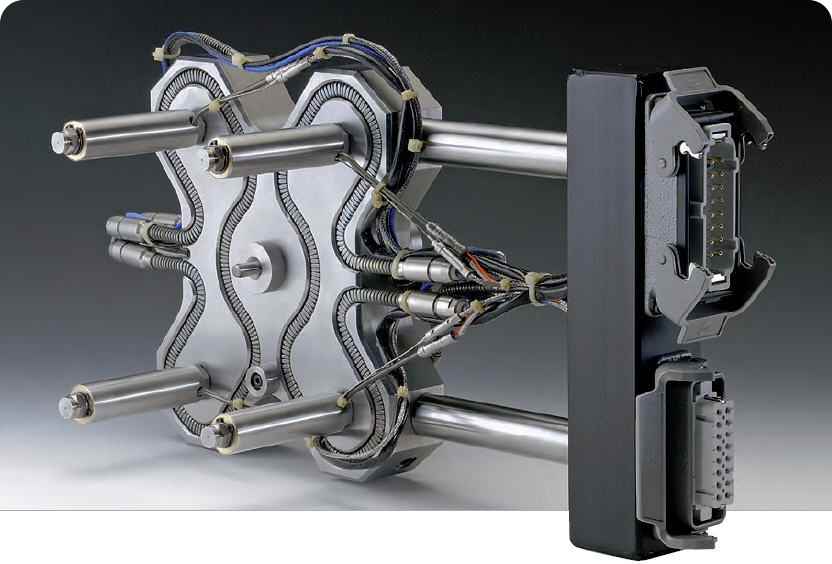
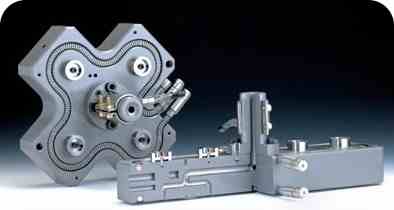 Most hot runner systems use the same core parts. The sprue bushing receives melt from the machine nozzle and feeds the manifold inlet. Its spherical radius must match the machine nozzle radius, commonly 0.5 or 0.75 inch. A mismatch causes melt leakage at the contact face.
The manifold distributes melt to every drop in parallel with the mold face. Builders machine it from H13 or similar hot-work tool steel. Melt channels are gun-drilled and sealed with plugs. Channel diameter follows the shot size and resin viscosity. Oversized channels increase residence time and risk degradation.
Drops, also called nozzles, carry melt perpendicular through the mold plates toward the cavity. Each drop contains its own heater and thermocouple for local control. Coil heaters, cartridge heaters, or band heaters supply the heat. Thermocouples sit close to the heater, not in the melt stream, for stable readings.
A standalone temperature controller powers each heater zone independently. Good controllers hold setpoint within about 1°C. Valve-gated systems add pneumatic or hydraulic actuation that sequences pin opening and closing.
Externally heated vs internally heated
Designers choose between two heating arrangements. Externally heated systems place heaters or heat conductors outside the melt channel. Heat reaches the melt through the steel body of the manifold and drops. This arrangement gives the most uniform melt temperature and suits heat-sensitive resins. Internally heated systems use a heated torpedo or probe centered inside the melt channel. Melt flows around the hot probe, which keeps construction simpler and cheaper. The trade-off is a less uniform temperature field and possible dead spots behind probe supports. Commodity resins with wide processing windows tolerate this design well.
| Feature | Externally heated | Internally heated |
|---|---|---|
| Heat source location | Outside the melt channel | Probe centered in the melt stream |
| Temperature uniformity | High | Moderate |
| Best suited for | Engineering and heat-sensitive resins | Commodity resins, simple parts |
| Tool cost | Higher | Lower |
| Color-change speed | Slower, larger melt volume | Faster |
Gate types
The gate type decides part appearance and process control. Thermal, or open, gates are the simplest option. Melt stays hot at the gate tip between shots. They leave a small vestige and cost the least. Stringing or drool can occur with some materials.
Valve gates use a pin that opens and closes each cycle. They leave the cleanest gate mark and shut off melt positively. Sequential valve gating fills large parts from several gates in a timed order. This technique moves weld lines to low-stress areas and can reduce clamp force. Valve gates cost more and need actuation hardware.
Some tools gate a hot drop into a short cold runner. This hybrid suits family molds or parts that need edge gating.
Key design considerations
- Balance the melt channels geometrically so every cavity fills at the same time and pressure. Unbalanced fill over-packs some cavities and short-shots others.
- Size channels for resin viscosity and shot weight. Narrow channels raise pressure drop and shear heating. Oversized channels extend residence time.
- Zone the heaters so manifold and drops hold setpoint independently. Insulate the manifold from mold plates with air gaps or titanium insulators.
- Allow for thermal expansion. A heated manifold grows measurably and must slide against its locating parts. Cold assembly needs matching clearances.
- Choose gate positions with the filling pattern in mind. Hot drops reach gate locations that parting-line runners and entrances cannot access.
- Keep residence time short for PVC, POM, and other heat-sensitive resins. Purge thoroughly at color or material changes.
Common mistakes
- Placing thermocouples too far from the heater, which causes temperature overshoot and degraded melt.
- Mismatching the sprue bushing radius to the machine nozzle, which leads to melt leakage.
- Routing heater and thermocouple wires without protection, so the mold bolsters pinch and short them during clamping.
- Running the nozzle tip too cold, which freezes the gate, or too hot, which causes stringing.
- Ignoring manifold expansion, which seizes plates and damages locating components.
- Oversizing melt channels for small shots, which degrades heat-sensitive resins during long residence.
Startup, shutdown, and maintenance
Heat the system in stages. Confirm every thermocouple reads correctly before reaching processing temperature. A pinched or broken thermocouple reports a false low reading, and the controller then overheats that zone. Verify heater resistance during preventive maintenance and replace weak heaters before they fail.
At shutdown, purge heat-sensitive resin from the manifold instead of letting it sit hot. Degraded material carbonizes in dead spots and later appears as black specks. Keep wiring channels clean and check connectors for corrosion.
Hot runner vs cold runner
| Factor | Hot runner | Cold runner |
|---|---|---|
| Material waste | None, no runner scrap | Runner scrap needs regrind or disposal |
| Cycle time | Often shorter, no runner cooling | Longer, runner must cool enough to eject |
| Tool cost | Higher | Lower |
| Maintenance | Heaters, seals, controllers | Minimal |
| Gate vestige | Small, valve gates cleanest | Larger, needs degating |
| Color or material change | Slower, more purge | Faster |
FAQ
Do hot runners work with all plastics?
Most thermoplastics run well in hot runners. Heat-sensitive resins like PVC need tight temperature control and short residence time. Thermosets need specially designed systems.
How much does a hot runner cost?
A simple hot sprue bushing costs a few hundred dollars. Multi-drop valve-gated systems can cost tens of thousands. Cavity count, gate type, and controller features drive the price.
Do hot runners reduce cycle time?
Often yes, because no runner needs cooling before ejection. Cooling of the part itself usually still sets the cycle. Review the full injection molding process to see where the cycle time goes.
What causes black specks with a hot runner?
Degraded resin hangs up in dead spots or overheated zones. Check temperature control, purge thoroughly, and inspect suspect heater zones.
Can a cold runner mold convert to hot runner?
Sometimes, but the mold needs space for the manifold, drops, and wiring. Plate thickness, clamp stroke, and ejection must all be rechecked. Gate position also affects flow orientation of the plastic melt.
Getting a hot runner mold built
Topworks Plastic Mold was founded in 2006. The company is headquartered in Huangyan, Taizhou, Zhejiang, and operates a manufacturing plant in Guangdong. Send your 3D files, material choice, and annual volume for a DFM review. Our engineers return a detailed mold quote within 24 hours.