What Is Injection Molding? A Complete Guide
Injection molding is the process that makes most plastic products — melting plastic and injecting it into a mold to form a part. This guide covers how it works step by step, the machine parts, materials, applications, costs, design rules, common defects and how it compares with 3D printing, CNC and blow molding.
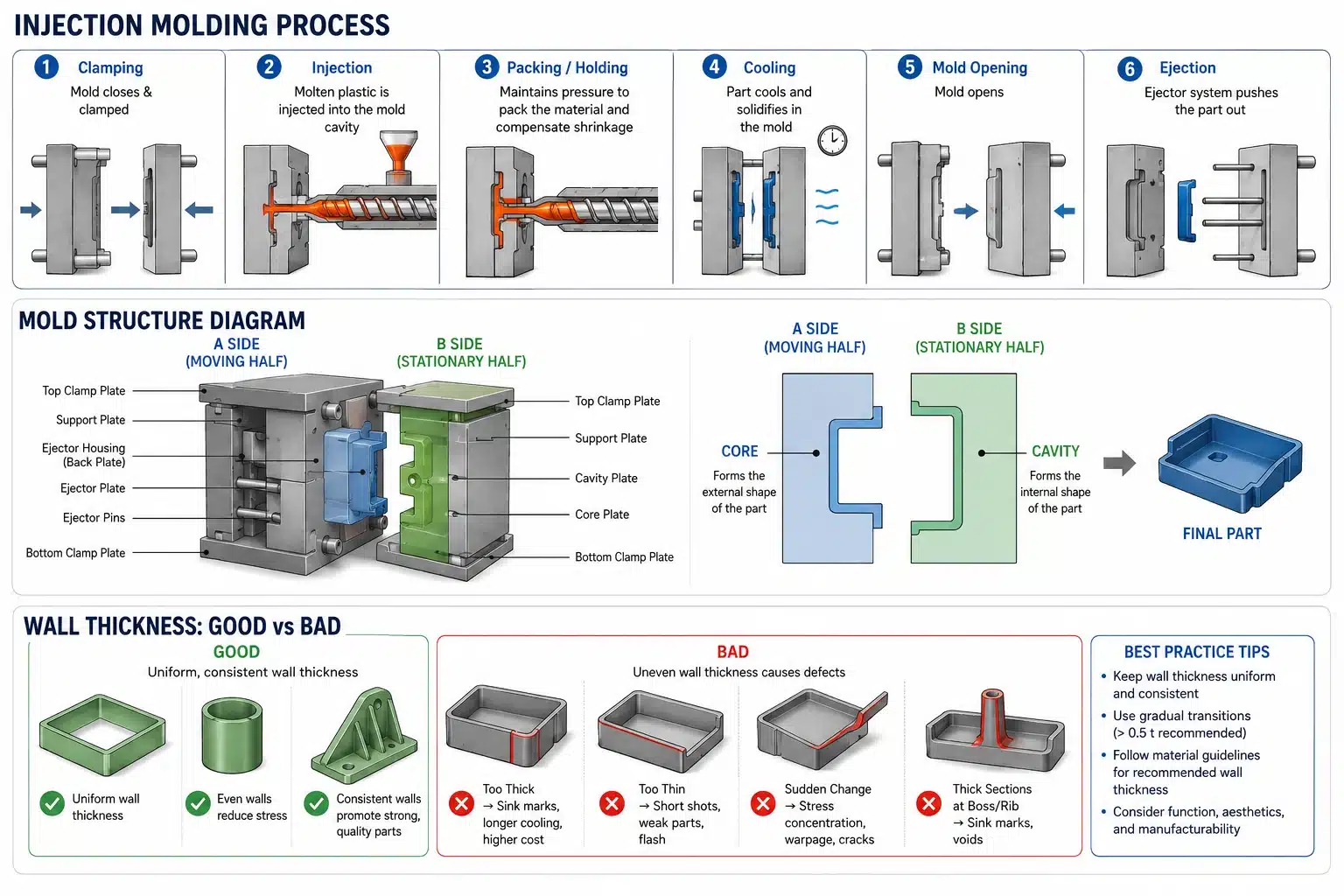
- The full molding cycle explained
- Materials, costs & design rules
- Defects & process comparisons
- Buyer’s mistakes to avoid
What Is Injection Molding?
Simple Definition
Injection molding is a manufacturing process used to produce large numbers of identical plastic parts. Plastic pellets are melted inside an injection molding machine, injected under pressure into a metal mold, cooled into the final shape, and then ejected as a finished part.
The process is especially suitable for high-volume production because the same mold can be used repeatedly to make thousands, hundreds of thousands, or even millions of parts with consistent shape, size, and quality.
In the United States, the spelling is usually injection molding. In the United Kingdom and many Commonwealth countries, it is often written as injection moulding. Both terms refer to the same process.
Simple Example
Think about a plastic bottle cap. The manufacturer does not cut each cap one by one. Instead, plastic material is melted, injected into a precision mold, cooled for a few seconds, and then ejected. The same cycle repeats continuously, allowing the factory to produce thousands of identical caps per hour.
How Does Injection Molding Work?
The injection molding process may look complex from the outside, but the basic idea is simple: melt the plastic, push it into a mold, cool it, and remove the finished part. In real production, each step must be carefully controlled because temperature, pressure, cooling time, material flow, and mold design all affect final quality.
The Basic Injection Molding Cycle
Clamping → Injection → Packing → Cooling → Ejection
| Stage | What Happens | Why It Matters |
|---|---|---|
| 1. Clamping | The two halves of the mold close tightly. | Prevents molten plastic from leaking out and causing flash. |
| 2. Injection | Melted plastic is injected into the mold cavity under pressure. | Forms the basic shape of the plastic part. |
| 3. Packing | Additional pressure is applied after the cavity is filled. | Compensates for material shrinkage and helps reduce sink marks. |
| 4. Cooling | The plastic cools and solidifies inside the mold. | Controls part stability, cycle time, and dimensional accuracy. |
| 5. Ejection | The mold opens and ejector pins push the part out. | Removes the finished part without damaging it. |
Step 1: Material Feeding
Plastic pellets are first loaded into a hopper. The pellets then enter the heated barrel of the injection molding machine. Depending on the product, the material may be ABS, PP, PE, PC, nylon, POM, TPE, TPU, or another engineering plastic.
Step 2: Melting and Plasticizing
Inside the barrel, a rotating screw moves the plastic forward while heat and friction melt the pellets. The goal is to create a consistent molten plastic that can flow smoothly into the mold.
Step 3: Injection Into the Mold
Once enough molten plastic is prepared, the screw moves forward like a plunger and injects the material through the nozzle, sprue, runner, and gate into the mold cavity. The cavity is the empty space shaped like the final part.
Step 4: Cooling and Solidification
Cooling usually takes the largest portion of the cycle time. The mold contains cooling channels that help remove heat from the plastic. Proper cooling is important because uneven cooling can cause warpage, shrinkage, and dimensional problems.
Step 5: Ejection
After the part is solid enough, the mold opens. Ejector pins, sleeves, or plates push the part out. If the part does not have enough draft angle, it may stick to the mold or show drag marks during ejection.
Main Parts of an Injection Molding System
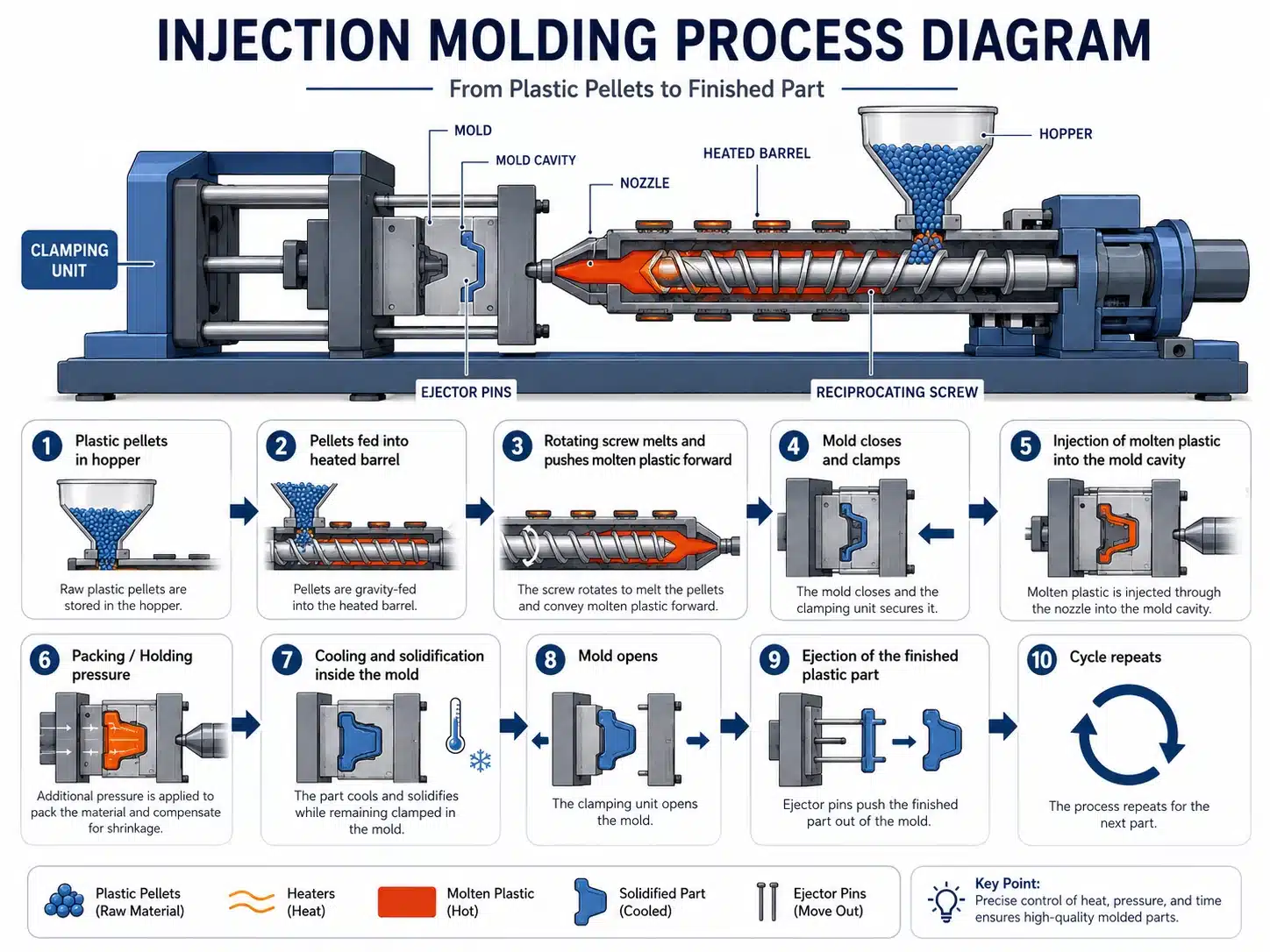
To understand injection molding, it helps to know the basic parts of the machine and mold. These parts work together to melt plastic, shape it, cool it, and remove it from the mold.
Injection Unit
The injection unit includes the hopper, barrel, screw, heater bands, and nozzle. Its job is to prepare the molten plastic and inject it into the mold at the right pressure, speed, and temperature.
Mold Unit
The mold is usually made from steel or aluminum. It contains the cavity and core, which form the outside and inside surfaces of the plastic part. The mold may also include runners, gates, cooling channels, inserts, slides, lifters, and ejector systems.
Clamping Unit
The clamping unit holds the mold closed during injection. If the clamping force is too low, the molten plastic can escape from the mold parting line and create flash.
Ejection System
The ejection system pushes the finished part out of the mold after cooling. Common ejection components include ejector pins, ejector plates, sleeves, and stripper plates.
| Component | Function |
|---|---|
| Hopper | Stores and feeds plastic pellets into the machine. |
| Barrel and Screw | Heat, mix, and move the plastic forward. |
| Nozzle | Transfers molten plastic from the machine into the mold. |
| Cavity and Core | Create the final shape of the molded part. |
| Runner and Gate | Guide plastic flow into the cavity. |
| Cooling Channels | Control mold temperature and reduce cycle time. |
| Ejector Pins | Push the finished part out of the mold. |
Common Materials Used in Injection Molding
One reason injection molding is so popular is the wide range of materials available. Different plastics offer different properties, such as strength, flexibility, heat resistance, chemical resistance, clarity, or low friction.
| Material | Common Applications | Key Advantages |
|---|---|---|
| ABS | Electronic housings, automotive trim, consumer products | Good impact resistance, easy processing, good surface finish |
| PP | Caps, containers, living hinges, household products | Lightweight, chemical resistant, cost-effective |
| PE | Packaging, containers, industrial parts | Tough, flexible, good chemical resistance |
| PC | Lenses, transparent covers, strong housings | High impact strength, transparency, heat resistance |
| PA / Nylon | Gears, mechanical parts, connectors | Wear resistance, strength, toughness |
| POM / Acetal | Precision gears, clips, sliding parts | Low friction, dimensional stability, stiffness |
| TPE / TPU | Soft grips, seals, flexible parts | Elasticity, soft touch, flexibility |
| PEEK | High-performance medical, aerospace, industrial parts | Excellent heat, chemical, and mechanical resistance |
How to Choose the Right Injection Molding Material
Material selection should not be based only on price. A product designer should consider how the part will be used, what loads it must withstand, whether it needs to resist heat or chemicals, and whether it must meet food-grade, medical, flame retardant, or outdoor-use requirements.
For example, PP may be suitable for a simple container, while PC may be better for a transparent protective cover. Nylon may be a good choice for a mechanical gear, while TPU may be better for a flexible grip or soft-touch component.
What Products Are Made by Injection Molding?
Injection molding is used across many industries because it can produce complex plastic parts quickly and consistently. Some parts are simple and low-cost, while others require tight tolerances, special materials, cleanroom production, or advanced mold structures.
Automotive Parts
Common automotive injection molded parts include dashboard components, clips, connectors, air vents, interior trim, light housings, sensor housings, and under-the-hood plastic parts. Automotive parts often require dimensional stability, heat resistance, and long-term durability.
Medical Components
Medical injection molding is used for syringe components, diagnostic device housings, surgical handles, test cartridge parts, caps, valves, and disposable medical products. These parts may require strict material control, clean production, and traceability.
Consumer Products
Many everyday products are injection molded, including toothbrush handles, toys, storage boxes, kitchen tools, cosmetic packaging, appliance parts, and furniture accessories.
Electronics
Electronic products often use injection molded enclosures, buttons, battery housings, connectors, switches, cable clips, and protective covers. These parts may need good appearance, dimensional accuracy, flame retardancy, or assembly features.
Packaging
Thin-wall containers, caps, lids, closures, and food packaging components are commonly produced by injection molding. In packaging, cycle time and mold efficiency are especially important because production volumes are usually very high.
Advantages of Injection Molding
Injection molding has several advantages that make it one of the most important plastic manufacturing processes in the world.
High Production Efficiency
Once the mold is ready and the process is stable, injection molding can produce parts quickly. Cycle times can range from a few seconds to over one minute depending on part size, wall thickness, material, and cooling design.
Low Unit Cost at High Volume
Although the mold can be expensive at the beginning, the cost per part becomes much lower as production volume increases. This is why injection molding is often used for mass production.
Consistent Quality
A well-designed mold and stable molding process can produce highly repeatable parts. This is important for products that must fit together, pass inspection, or meet strict dimensional requirements.
Complex Part Geometry
Injection molding can produce parts with ribs, bosses, clips, snap-fits, threads, logos, textures, and complex internal or external shapes. However, complex features must be designed carefully to avoid mold cost increases or production defects.
Wide Material Selection
From low-cost commodity plastics to high-performance engineering resins, injection molding supports a broad range of materials. Fillers such as glass fiber, mineral filler, or flame retardant additives can also be added when needed.
Disadvantages and Limitations of Injection Molding
Injection molding is powerful, but it is not the best choice for every project. Understanding its limitations helps avoid expensive mistakes.
High Upfront Mold Cost
The biggest limitation is tooling cost. A mold must be designed, machined, assembled, tested, and adjusted before mass production. For simple parts, tooling may be relatively affordable. For complex parts with slides, lifters, tight tolerances, textured surfaces, or multiple cavities, the mold cost can increase significantly.
Design Changes Can Be Expensive
Before a mold is cut, design changes are relatively easy. After steel has been machined, changes become more difficult and costly. This is why product designers should complete DFM review and prototype validation before starting production tooling.
Not Ideal for Very Low Volume
If you only need a few parts, 3D printing or CNC machining is usually more practical. Injection molding becomes more attractive when the production quantity is high enough to spread the mold cost across many parts.
Design Rules Must Be Followed
Injection molded parts need proper wall thickness, draft angles, radii, gate position, rib design, and ejection planning. Ignoring these rules can lead to sink marks, warpage, short shots, flash, or difficult ejection.
How Much Does Injection Molding Cost?
Injection molding cost depends on the part design, mold complexity, material, production volume, tolerance requirements, surface finish, and quality standards. There is no single fixed price because two plastic parts of the same size can have very different tooling costs if one is simple and the other has undercuts, tight tolerances, or cosmetic requirements.
| Cost Factor | How It Affects Price |
|---|---|
| Part Size | Larger parts require larger molds, more material, and bigger machines. |
| Mold Complexity | Slides, lifters, inserts, threads, and undercuts increase tooling cost. |
| Number of Cavities | Multi-cavity molds cost more upfront but reduce unit cost in high-volume production. |
| Material | Engineering plastics and filled materials are usually more expensive than commodity plastics. |
| Tolerance | Tight tolerances require more precise tooling and better process control. |
| Surface Finish | Polishing, texture, painting, plating, or special appearance requirements add cost. |
| Production Quantity | Higher volume usually reduces the average cost per part. |
Prototype Mold vs Production Mold
A prototype mold is usually built for design validation, small batches, or market testing. It may use aluminum or simplified steel construction and may not be designed for very long tool life.
A production mold is built for stable long-term manufacturing. It usually requires better steel, more precise machining, stronger cooling design, and a more durable structure. Although it costs more upfront, it is better for high-volume production.
When Does Injection Molding Become Cost-Effective?
As a practical rule, injection molding becomes more attractive when the design is stable and the production quantity is high. For very small quantities, 3D printing or CNC machining is often cheaper. For thousands or tens of thousands of parts, injection molding may offer a much lower unit cost.
| Quantity Range | Recommended Manufacturing Method |
|---|---|
| 1–100 parts | 3D printing or CNC machining is usually better. |
| 100–1,000 parts | Consider CNC, urethane casting, bridge tooling, or prototype molding. |
| 1,000–10,000 parts | Injection molding may be suitable depending on part design and budget. |
| 10,000+ parts | Injection molding is often the most economical option. |
Basic Design Rules for Injection Molded Parts
Good part design reduces mold cost, improves quality, and prevents production problems. Many injection molding defects begin at the design stage, not on the production floor.
Keep Wall Thickness Uniform
Uneven wall thickness can cause sink marks, warpage, and inconsistent cooling. A part with thick and thin sections will cool at different speeds, which can pull the plastic out of shape.
Add Draft Angles
Draft angle means slightly tapering vertical walls so the part can be ejected from the mold more easily. Without draft, the part may stick to the mold, scratch during ejection, or require excessive ejection force.
Avoid Sharp Corners
Sharp internal corners can create stress concentration and make plastic flow less smoothly. Adding proper radii improves strength, flow, and moldability.
Use Ribs Instead of Thick Walls
Ribs can increase strength without making the whole wall thicker. This helps reduce material usage, cooling time, sink marks, and warpage.
Avoid Undercuts When Possible
Undercuts often require slides, lifters, or collapsible cores. These mechanisms increase mold cost, mold maintenance, and production complexity. If the same function can be achieved without an undercut, the mold will usually be simpler and cheaper.
Plan Gate Location Early
The gate is where molten plastic enters the part cavity. Gate location affects appearance, strength, weld lines, shrinkage, and warpage. For cosmetic parts, gate marks should be placed in less visible areas when possible.
Common Injection Molding Defects
Even with a good machine and experienced operators, defects can occur if the material, mold design, part design, or process settings are not suitable. Understanding common defects helps designers and buyers communicate better with mold makers and injection molding suppliers.
| Defect | What It Looks Like | Common Causes | Prevention |
|---|---|---|---|
| Sink Marks | Small depressions on the surface | Thick walls, poor packing, uneven cooling | Use uniform wall thickness and proper rib design. |
| Warpage | The part bends or twists | Uneven cooling, poor wall design, internal stress | Improve cooling, wall thickness, and gate position. |
| Flash | Thin extra plastic along edges | Low clamping force, worn mold, excessive pressure | Check mold fit, clamping force, and process settings. |
| Short Shot | The part is incomplete | Poor flow, low injection pressure, blocked gate | Improve material flow, temperature, pressure, and gate design. |
| Weld Line | A visible line where flow fronts meet | Multiple flow paths, holes, inserts, low melt temperature | Optimize gate position, temperature, and part design. |
| Burn Marks | Dark or scorched areas | Trapped air, high injection speed, poor venting | Add venting and adjust injection speed. |
Injection Molding vs Other Manufacturing Methods
Injection molding is not always the first step in product development. Many companies start with 3D printing or CNC machining, then move to injection molding after the design is tested and demand is proven.
| Method | Best For | Upfront Cost | Unit Cost at High Volume | Design Flexibility |
|---|---|---|---|---|
| Injection Molding | High-volume plastic parts | High | Low | Low after mold is made |
| 3D Printing | Prototypes and low-volume parts | Low | High | Very high |
| CNC Machining | Precision prototypes and low-volume parts | Medium | Medium to high | Medium |
| Thermoforming | Large plastic shells and trays | Medium | Medium | Medium |
| Blow Molding | Hollow products such as bottles | High | Low | Limited to hollow shapes |
Injection Molding vs 3D Printing
3D printing is better for fast prototypes, design testing, and low-volume production. Injection molding is better when the design is finalized and the production quantity is high enough to justify the mold cost.
Injection Molding vs CNC Machining
CNC machining removes material from a solid block. It is useful for prototypes, metal parts, and precision low-volume parts. Injection molding is more efficient for mass-producing plastic parts with repeatable geometry.
Injection Molding vs Thermoforming
Thermoforming heats a plastic sheet and forms it over a mold. It is often suitable for large, thin plastic parts such as trays, panels, and covers. Injection molding is better for smaller, more detailed, three-dimensional parts with complex features.
Injection Molding vs Blow Molding
Blow molding is mainly used for hollow products such as bottles, tanks, and containers. Injection molding is usually used for solid or detailed plastic parts.
Is Injection Molding Right for Your Product?
Injection molding is a good choice when your design is stable, your expected production volume is high, and you need consistent plastic parts with reliable quality. It may not be the right choice if you are still testing the design or only need a few samples.
Use Injection Molding If:
- You need thousands or millions of identical plastic parts.
- Your product design has already been tested and finalized.
- You need consistent quality and repeatable dimensions.
- You want lower unit cost at high volume.
- You need production-grade plastic materials.
- You are ready to invest in mold tooling.
Consider Other Methods If:
- You only need a few prototypes.
- Your design is still changing frequently.
- You cannot afford the upfront tooling cost.
- You need parts immediately and cannot wait for mold development.
- Your geometry is too complex for simple tooling without redesign.
Simple Decision Guide
| Question | Recommended Direction |
|---|---|
| Do you need fewer than 100 parts? | Start with 3D printing or CNC machining. |
| Is your design still changing? | Prototype first before building an injection mold. |
| Do you need 1,000+ parts? | Evaluate injection molding or bridge tooling. |
| Do you need 10,000+ parts? | Injection molding is likely worth serious consideration. |
| Does the part have undercuts or tight tolerances? | Request DFM review before mold quotation. |
Common Mistakes Before Starting an Injection Mold Project
Many injection molding problems can be avoided before the mold is made. Buyers and product developers should pay attention to the following mistakes.
Asking for a Mold Quote Too Early
If the 3D model has not been reviewed for moldability, the quote may be inaccurate. A proper DFM review can identify wall thickness problems, undercuts, poor gate locations, missing draft angles, and risky cosmetic areas.
Choosing the Cheapest Mold Without Understanding Tool Life
A low-cost mold may be acceptable for a small batch, but it may not survive long-term production. Buyers should confirm the expected tool life, steel type, cavity number, cooling design, and maintenance plan.
Ignoring Material Shrinkage
Different plastics shrink at different rates after cooling. The mold must be designed with material shrinkage in mind. If the wrong material is chosen after the mold is already made, dimensional problems may occur.
Changing the Design After Mold Cutting
Late design changes can be expensive. Adding material to a mold is usually more difficult than removing steel. This is why prototype testing and design confirmation are important before tooling begins.
Not Defining Quality Standards
Before production, both buyer and supplier should confirm dimensions, tolerances, color, texture, surface finish, inspection method, packaging, and acceptable defect limits.
Injection Molding and Sustainability
Plastic manufacturing faces increasing pressure to reduce waste and improve sustainability. Injection molding can be more efficient when the product, mold, material, and production process are designed properly.
Reducing Material Waste
Cold runner molds create runner waste, although some materials can be reground and reused within controlled limits. Hot runner molds can reduce runner waste, especially in high-volume production, but they cost more and require more technical maintenance.
Choosing Recyclable Materials
Using mono-material designs and recyclable thermoplastics can make the final product easier to recycle. Material selection should consider both product performance and end-of-life handling.
Improving Mold and Process Efficiency
Efficient cooling, optimized cycle time, stable processing, and proper maintenance can reduce energy use and scrap rate. A well-designed mold is not only better for quality but also better for production efficiency.
Frequently Asked Questions About Injection Molding
What is injection molding in simple terms?
Injection molding is a process that melts plastic and injects it into a mold to make a shaped plastic part. After the plastic cools, the mold opens and the finished part is ejected.
What is plastic injection molding used for?
It is used to make automotive parts, medical components, electronic housings, packaging, toys, household products, industrial parts, and many other plastic products.
What materials are used in injection molding?
Common materials include ABS, PP, PE, PC, nylon, POM, TPE, TPU, and high-performance plastics such as PEEK. The best material depends on strength, flexibility, heat resistance, chemical resistance, appearance, and cost requirements.
Is injection molding expensive?
Injection molding has a high upfront mold cost, but the unit cost can become very low in high-volume production. It is usually not cost-effective for only a few parts, but it can be highly economical for thousands or millions of parts.
How long does injection molding take?
Mold development can take days to weeks depending on complexity. Once production starts, each molding cycle may take from a few seconds to over one minute depending on part size, wall thickness, material, and cooling time.
What is the difference between injection molding and 3D printing?
3D printing is better for prototypes and small quantities because it does not require a mold. Injection molding requires tooling but is much more efficient for high-volume production.
What are common injection molding defects?
Common defects include sink marks, warpage, flash, short shots, weld lines, burn marks, flow marks, and drag marks. These defects may come from poor part design, mold design, material selection, or processing conditions.
What should I prepare before requesting an injection molding quote?
Prepare a 3D CAD file, 2D drawing if available, material requirement, expected quantity, surface finish, color, tolerance, target application, and any special quality or regulatory requirements.
Conclusion: Injection Molding Is Best for Stable, High-Volume Plastic Parts
Injection molding is one of the most important processes in modern plastic manufacturing. It can produce strong, consistent, complex plastic parts at a low unit cost when production volume is high enough.
However, successful injection molding depends on more than just having a mold. Good product design, proper material selection, mold engineering, process control, and quality inspection all play important roles.
If your product design is still changing, start with prototyping. If your design is stable and you need thousands or more plastic parts, injection molding may be the right path from prototype to mass production.
Need Help With an Injection Molded Part?
Before investing in tooling, it is important to check whether your part is suitable for injection molding. A professional DFM review can help identify wall thickness issues, undercuts, gate location problems, material risks, and cost-saving opportunities.
Prepare your 3D file, target material, quantity, and product requirements, then request a manufacturability review before starting mold production.
Need help with an injection molded part?
Send your part or idea and we’ll advise on material, design and tooling — and give you a quote you can act on.
- Free DFM before steel is cut
- Material and design guidance
- Factory-direct tooling in China