Flip Top Cap Mould, Bump Lotion & Closure Mould
China’s leading reliable plastic cap mould supplier with over 15 years of experience. One stop service — quick delivery, rich experience, top quality. Mould steel P20, H13 and S136.

- 15+ years cap mould experience
- 7 cap mould types
- P20 / H13 / S136 steel
- Design to delivery, one stop
Your one-stop cap mould partner
Topworks - ведущий китайский поставщик надежных пресс-форм для пластмассовых крышек с более чем 15-летним опытом работы. Мы предлагаем быструю доставку, богатый опыт и высочайшее качество пресс-форм для крышек.
Мы предлагаем широкий выбор высококачественных пресс-форм для изготовления пластмассовых крышек, которые идеально подходят для разработки, создания прототипов и производства продукции.
Мы стремимся к тому, чтобы изготовление качественных форм для крышек with mould steel P20, H13 and S136.
Cap mould range
- Формы для изготовления навесных замков
- Форма для излива Yorker
- Форма для изготовления крышек для дисков
- Форма для изготовления крышек с откидным верхом
- Пресс-форма для изготовления крышек
- Форма для изготовления крышек с поворотным механизмом открытия/закрытия
- Формы для изготовления заслонок

Cap & closure mould gallery


How to design screw cap, lid & closure moulds
Undercuts on the inside of a cap — typically inside threads, snap-on ribs, or major undercuts that are part of the product shape — require careful design decisions. The planned method of manufacture (molding, or machining after molding) should be considered. The пресс-форма для крышки может быть гораздо проще, если колпачок резьбовая после формовки. Важнее получить продукт с наименьшей общей стоимостью, чем самый элегантный метод производства.
Inside threads on cap
Если резьба должна быть формованной, существуют два варианта способа извлечения изделия из сердечника: вывинчивание или снятие. Конструктор должен тщательно продумать необходимые объемы производства. Механическая обработка после формовки может значительно снизить сложность и стоимость пресс-формы при небольших объемах производства.
Unscrewing method
Стандартная резьба обычно состоит более чем из одного шага. Во многих винтовых крышках для бутылок, банок и тюбиков зубной пасты, от двух до шести подач встречаются довольно часто. More turns mean longer products, more plastic, more molding time, and longer cycles. In many closures, a thread length of one or two pitches is sufficient for good holding power.
Сайт зачистное кольцо удерживает колпачок, чтобы его можно было отвинтить от сердцевины. Снаружи колпачок должен иметь ребра или выступы, за которые может зацепиться внешнее устройство для отвинчивания. Конструкция этих приспособлений должна быть обсуждена с разработчик пресс-форм.
Любой метод отвинчивания требует либо сложных пресс-формы для крышек или специальные машины. Циклы формовки также медленнее, чем у аналогичных изделий, не требующих отвинчивания.
Выброс полос (силовой выброс)
Стриппинг - это самое простое и зачастую недорогое решение для извлечения колпачка или крышки. Поскольку пресс-форма для крышки opens and after the cavity has moved away from the core side, the ejection starts caused by the stripper moving forward. The plastic cap is pushed over the hump in the core, causing the plastic to expand so that the portion inside the groove can slip out.
Легкость снятия зависит от многих не менее важных факторов: угла наклона резьбы, высоты выступа, диаметра, а также типа пластика и его модуля упругости.
Factors affecting stripping ability
Угол резьбы (α): Чем больше угол, тем сложнее процесс извлечения. Острый угол (α = 90°) делает выталкивание практически невозможным - пластиковый колпачок скорее срежется в канавке, чем вытащится.
Высота “h” против диаметра “d”: The percentage of stretching f is directly proportional to height h and inversely proportional to diameter d. The greater the cap diameter d, the easier the cap will slip out of its groove. A cap from relatively stiff plastic could be stripped if d is large, but would break during ejection if d is small.
Количество резьб (шагов): Самый простой способ снятия - указать только одну нить (один шаг), чтобы снятая нить не соскальзывала в соседний паз, а продолжала непрерывно соскальзывать с сердечника.
The finish of the groove also influences the ease of stripping, especially with materials requiring high polish for good ejection.
Figure 1 — Stripping influences
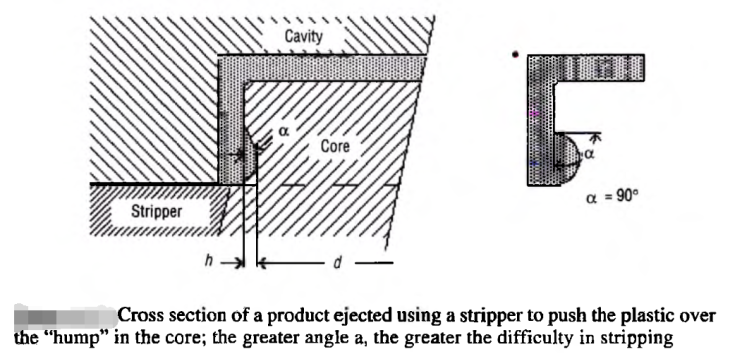
Influences affecting the ability to strip a cap. The greater the angle α is, the greater the difficulty in stripping. При необходимости резьба винта может быть выполнена под углом 90°., Но в этом случае необходимо откручивать - снятие невозможно.
Many screw threads — especially threads for closures — have standardised shapes which originally evolved from threads on glass bottles and jars. Such standards should be followed, and their large tolerances used to obtain maximum benefits for plastic threads.
Если учесть все факторы, влияющие на снятие, конструктору удастся создать винтовую крышку с правильной формой сечения резьбы и подходящим соотношением h/d, чтобы даже относительно жесткий пластик можно было легко снять, без необходимости отвинчивания. пресс-форма для колпачков.
Need a cap or closure mould?
Send your cap drawing, material spec, and annual volume. We’ll reply with DFM notes, steel recommendation, and a clear quotation.
- Flip-top, hinged, disc-top, push-pull, twist, yorker, flapper
- P20 / H13 / S136 mould steel
- 15+ years cap mould experience
- Quick delivery, one stop service
Cap & closure mould FAQ
What types of cap moulds do you make?
We manufacture moulds for flip-top caps, hinged closures, disc-top caps, push-pull caps, twist open/close caps, yorker spout caps, and flapper closures — covering bottles, jars, tubes, and cosmetic packaging.
What mould steels do you use for cap moulds?
P20 for general production, H13 for high-wear and abrasive-filler applications, and S136 for corrosion resistance with aggressive resins. Steel choice depends on resin, surface requirement, and target mould life.
Should cap threads be molded or machined after molding?
It depends on volume. For high-volume production, molding the threads is more efficient — the cap mould uses unscrewing or stripping ejection. For lower volumes, machining threads after molding can simplify the mould and reduce cost significantly.
What is the difference between unscrewing and stripping ejection?
Unscrewing rotates the cap off the core — required for deep or sharp-angle threads, but needs a more complex mould and longer cycle. Stripping pushes the cap over the core hump by force — simpler and faster, but only works when thread angle, h/d ratio, and plastic flexibility allow it.
How do I know if my cap design can be stripped?
Key factors: thread angle α (must not be 90°), projection height h relative to cap diameter d (smaller h/d = easier stripping), number of pitches (one pitch is easiest), and the plastic’s modulus of elasticity. We run DFM analysis to confirm strippability before cutting steel.
What is the typical lead time for a cap mould?
30–50 days from design approval depending on cap type, cavity count, and unscrewing mechanism complexity. Trial parts and inspection reports are provided before shipment.
Can you make multi-cavity cap moulds?
Yes. Cap moulds commonly run 4, 8, 16, or higher cavities depending on annual volume and press size. Higher cavitation lowers per-part cost but increases mould investment and lead time.